Anyone looking to gain weight, lose weight or gain muscle mass needs to understand what the Basal Metabolic Rate (BMR) is and how it can define their results with training and diet.
Our body is powered primarily by energy obtained from nutrients in food, such as proteins, carbohydrates and glucose.
The number of calories is nothing more than a unit of measurement, which refers to the amount of energy you can obtain from macronutrients (carbohydrates, fats, proteins) in food .
The basal rate, more precisely the Basal Metabolic Rate (BMR), is the minimum amount of calories an individual needs to maintain vital functions at rest – such as breathing, heartbeat and maintenance of body temperature.
The more active an individual is, the higher their Basal Metabolic Rate (BMR) will be. In addition, other factors also influence BMR, such as age, sex, body composition (muscle mass vs. fat), genetics, diet, smoking, physical activity, menstrual cycle, and ethnicity.
The average Basal Metabolic Rate (BMR) for men is around 1696 calories per day, while for women it is around 1410 calories per day.
Physical exercise and manual labor can significantly increase daily calorie expenditure. Running, for example, can burn 600 to 1,000 calories per hour, depending on the intensity and the person's weight. Cycling on an exercise bike can burn 500 to 800 calories per hour.
Calculate Basal Metabolic Rate (BMR)
Therefore, when calculating your BMR, it is important to take into account your work and training routine.
Some mathematical formulas help to estimate an individual's energy expenditure:
Formula for men:
BMR = activity rate factor x {66 + [(13.7 x Weight(kg)) + ( 5 x Height(cm)) – (6.8 x Age(years))]}
Formula for women:
BMR = activity rate factor x {655 + [(9.6 x Weight(kg)) + (1.8 x Height(cm)) – (4.7 x Age(years))]}
Activity rate:
- Sedentary (little or no exercise) factor = 1.2
- Lightly active (light exercise 1 to 3 days per week) factor = 1.375
- Moderately active (moderate exercise, does sports 3 to 5 days a week) factor = 1.55
- Highly active (heavy exercise 5-6 days per week) factor = 1.725
- Extremely active (heavy exercise daily and up to 2 times a day) factor = 1.9
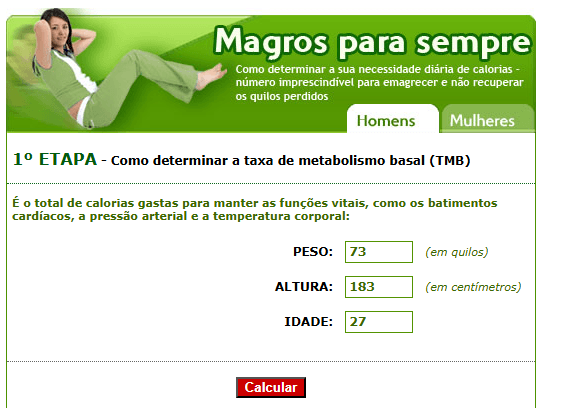
Another simpler way to perform this calculation is through calculators available on the internet. One of them is from Unimed:






Comments (0)